

When people picture Texas industry, oil derricks and cattle ranches often come to mind first. But beneath that iconic imagery lies a thriving, highly technical manufacturing sector that quietly shapes the products Americans use every day. Plastics manufacturing — and specifically the precision craft of injection molding — has taken deep root across the state, making Texas one of the nation's major injection molding hubs.
Why Texas Became a Manufacturing Magnet
Geography, infrastructure, and economics have long made Texas an attractive destination for industrial investment. The state sits at a logistical crossroads, with major interstate highways, multiple international ports, rail networks, and two of the country's busiest airports converging within its borders. For manufacturers, this means raw materials arrive faster and finished products ship further without delay.
Add to that a business climate consistently ranked among the most favorable in the nation — a business-friendly tax environment, extensive transportation infrastructure, and a large manufacturing workforce — and it becomes clear why plastics manufacturers have planted flags here for decades. Texas Injection Molding operations benefit from all of these structural advantages, allowing shops to operate leaner and deliver faster than competitors in higher-cost states.
What Injection Molding Actually Does
Despite being one of the most common industrial processes in the world, injection molding remains poorly understood outside manufacturing circles. At its core, the process involves melting plastic resin pellets and injecting the molten polymer under controlled pressure into a precision-machined mold cavity. The material is then packed to compensate for shrinkage, cooled until it solidifies, and finally ejected from the mold as a finished plastic part ready for use or assembly.
The elegance of the process lies in its repeatability. A well-designed mold can produce tens of thousands — sometimes millions — of identical parts with tolerances measured in thousandths of an inch. This consistency makes injection molding indispensable for industries where failure is not an option: medical devices, automotive components, aerospace assemblies, consumer electronics, and food-safe packaging.
Texas, with its dense concentration of oil refineries and petrochemical plants, also sits close to the raw material supply chain. Polypropylene, polyethylene, ABS, nylon, and polycarbonate — the workhorses of the molding world — are largely derived from petroleum byproducts, many of which are processed right here in the Gulf Coast region. This proximity cuts lead times and transportation costs for local molders, creating a meaningful competitive edge.
The Breadth of Texas Injection Molding Applications
Walk through any Texas hospital, and the IV connectors, syringe components, and device housings around you are commonly produced using injection molding, and many are supplied by manufacturers operating in Texas. Visit an automotive plant in San Antonio or Arlington, and you'll find that many interior panels, clips, fluid reservoirs, and other plastic components are manufactured using injection molding, with many supplied by regional manufacturers. Even the agriculture sector, so central to Texas identity, relies on molded plastic irrigation fittings, equipment housings, and seed trays produced by regional shops.
The diversity of applications served by Texas injection molding operations is genuinely staggering. A single mid-sized shop might run aerospace-grade polysulfone components on one machine while producing colorful children's toy parts on the next. This versatility is a hallmark of the industry in the state — an ability to pivot between sectors, serve multiple markets simultaneously, and respond to demand shifts without the slowdowns that plague more specialized operations elsewhere.
Technology Raising the Bar
Texas molding shops are not coasting on low costs alone. Investment in technology has surged across the industry. Modern operations in cities like Houston, Dallas-Fort Worth, Austin, and San Antonio run sophisticated equipment: all-electric injection presses with servo-driven precision, robotic sprue pickers and part-handling automation, in-mold labeling systems, and real-time process monitoring software that flags deviations before a single defective part leaves the press.
Scientific molding methodology has become standard practice among the state's best shops. Rather than relying on tribal knowledge and press-side intuition, engineers use systematic decoupled molding processes—separating fill, pack, and hold phases—to develop robust, repeatable processes documented to survive machine changes, material lot variations, and operator turnover. The result is tighter quality, less scrap, and shorter validation cycles for customers bringing new products to market.
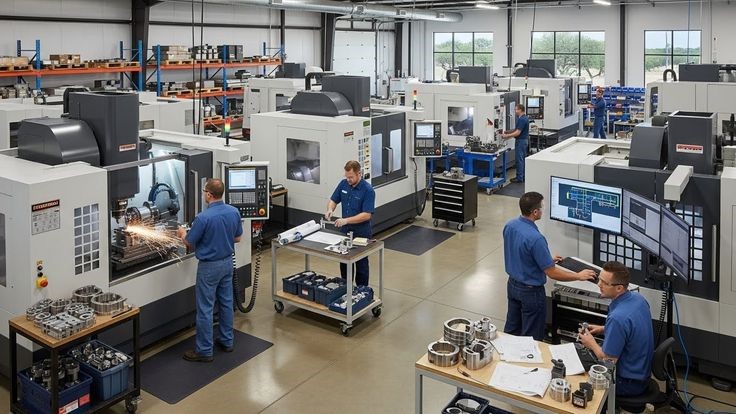
Tooling technology has kept pace as well. Many Texas operations maintain in-house toolrooms equipped with high-speed CNC machining centers, EDM (electrical discharge machining) equipment, and coordinate measuring machines. Building and modifying molds internally shortens lead times dramatically and gives engineers direct control over tool quality — a critical advantage when a customer needs a design revision turned around in days, not weeks.
Workforce and the Future Pipeline
Any manufacturing sector is only as strong as its workforce, and Texas has invested substantially in building a skilled trades pipeline. Community colleges and technical institutes across the state offer programs in plastics technology, precision machining, and industrial maintenance. Industry associations have worked with educators to develop a curriculum that reflects what employers actually need on the shop floor.
The challenge ahead is attracting the next generation to careers in manufacturing. Shops that have modernized their floors — introducing robotics, digital monitoring, and cleaner environments — are finding it easier to recruit younger workers who grew up expecting technology in the workplace. The stereotype of injection molding as dark, dirty, and repetitive is giving way to a reality that looks far more like a data-driven production environment.
A Sector Built to Last
Texas injection molding is not a trend or a transitional industry waiting to be disrupted. The demand for precision plastic components is expected to continue growing as medical devices become more sophisticated, electric vehicles require new polymer solutions, and consumer products continue to lean on lightweight, durable plastics. Texas is positioned — geographically, economically, and increasingly technologically — to meet that demand at scale.
For the companies sourcing plastic components and the engineers designing tomorrow's products, the message from the Lone Star State is straightforward: the capability is here, the capacity is here, and the infrastructure to support serious production is already in place. Texas has earned its place as one of America's major centers for injection-molded plastics and is well positioned to support future manufacturing growth.