

Concrete is the most widely used building material. The densest and strongest concrete is obtained when the cement paste fills the voids between sand particles, and the resulting mortar fills the voids in the coarse aggregate. Every grain of sand should be fully coated with cement paste to achieve proper bonding and strength.
Before the invention of mechanical mixers, the entire mixing process was carried out manually using shovels and shallow mixing boxes. However, due to the increasing demand in modern construction, various mechanical procedures and machines are now used to ensure uniform mixing and higher productivity. The concrete mixer was invented by Gebhardt Jaeger, an industrialist from Columbus, Ohio.
What is a Concrete Mixer?
A concrete mixer is a machine used to produce a homogeneous mixture of concrete by uniformly blending cement, aggregate (sand or gravel), water, and admixtures.
The basic components of a concrete mixer include the feeding unit, mixing drum or pan, discharging unit, power transmission system, and water supply system.
The mixing process promotes particle collision, dispersion, and uniform coating of aggregates with cement paste. Usually, this machine consists of three main units: the feeding unit, the mixing unit, and the discharge unit.
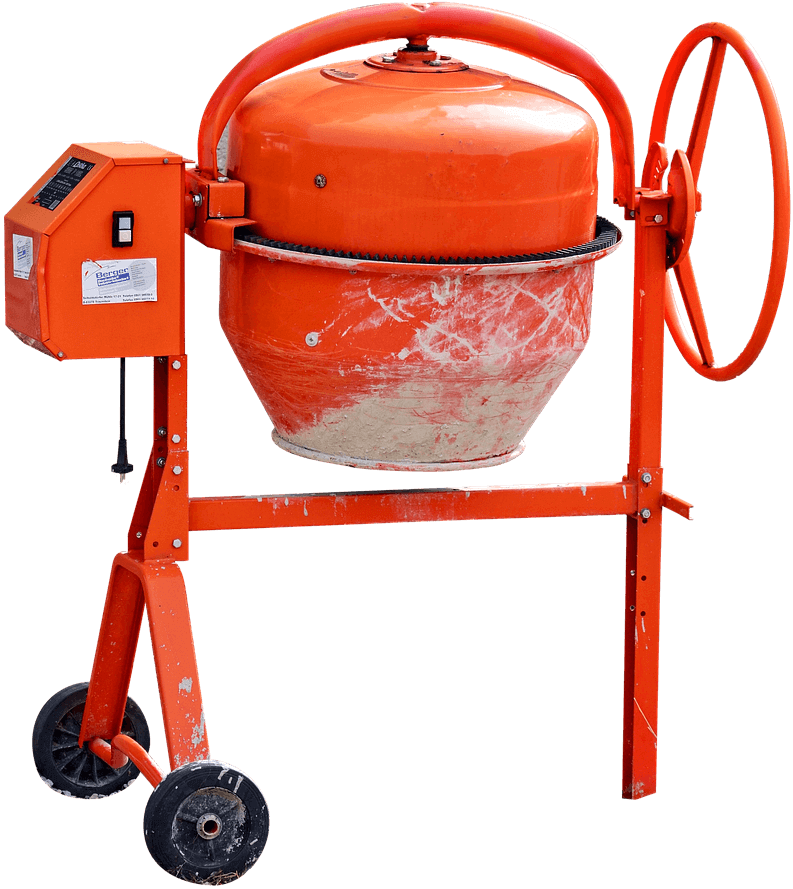
Types of Concrete Mixers
With technological advancement, the design of concrete mixers has evolved significantly. Concrete mixers can broadly be divided into gravity mixers and forced mixers. Today, twin-shaft mixers, vertical axis mixers, and drum mixers are commonly used in construction projects.
The following are the types of concrete mixing machines:
- Based on Working Principles
- Based on Mixing Methods
- Based on the Shape of Concrete Mixers
- Based on the Discharging Method
- Commonly Used
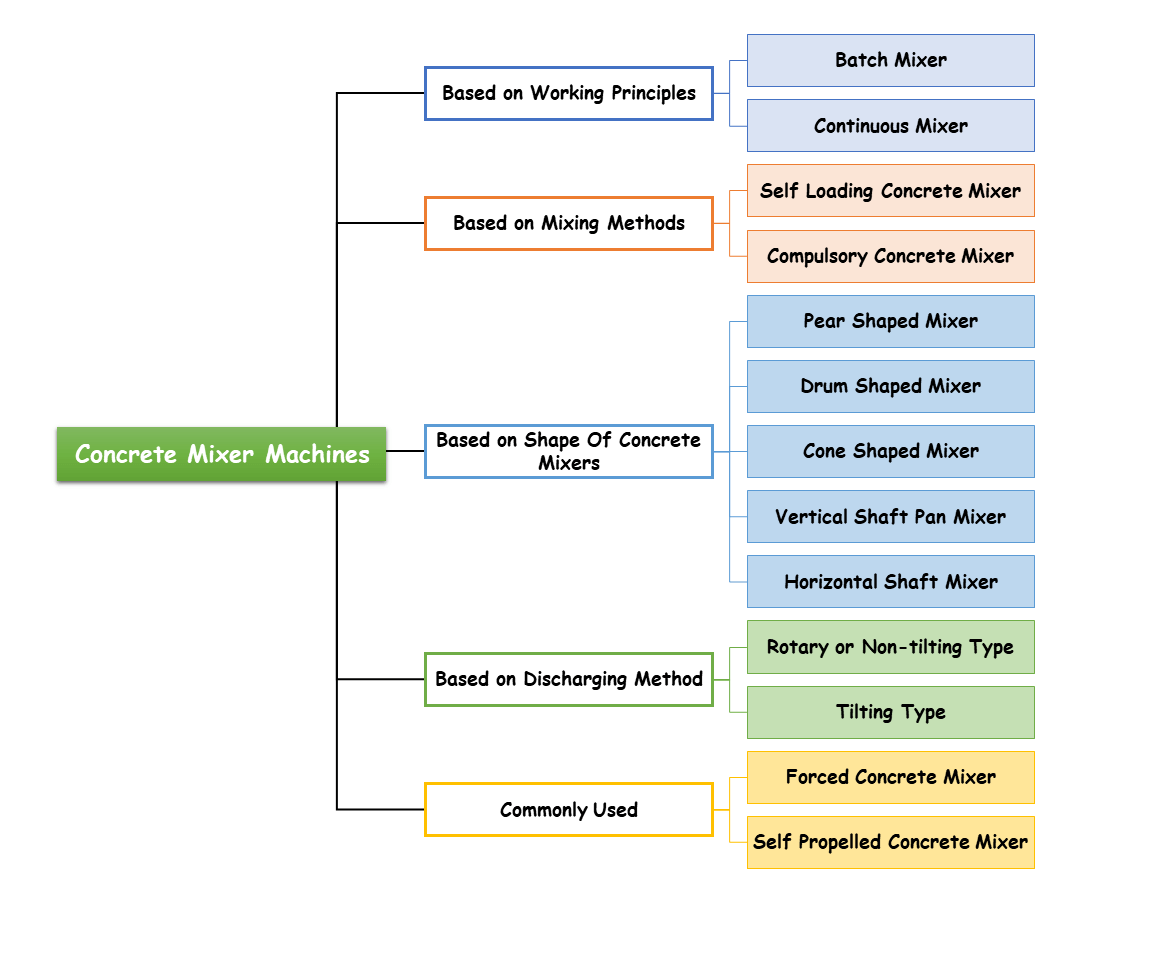
A brief description of these types of mixing machines is given below.
Batch Concrete Mixer
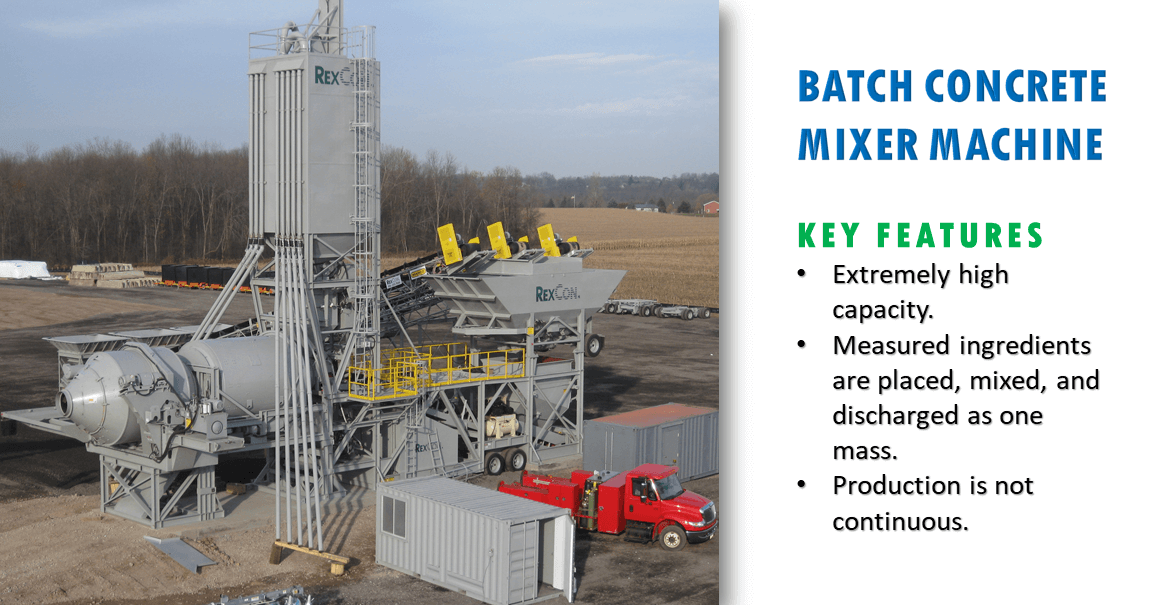
Batch mixers are those in which measured ingredients are placed, mixed, and discharged as a single batch. This differs from continuous mixers where materials are fed and discharged continuously.
Features:
- High capacity (batches up to 3785 liters).
- Includes drum mixers, pan mixers, and open-top mixers.
- Available as gravity and revolving drum types.
- Revolving mixers contain shelves and projections inside the drum to improve mixing efficiency.
Continuous Concrete Mixer
Continuous mixers operate by continuously feeding ingredients and discharging mixed concrete as a steady stream.
Features:
- Higher productivity than batch mixers.
- Material proportion and mixing time are comparatively difficult to control.
- Feeding, mixing, and discharge occur simultaneously in a long mixing drum.
Self Loading Concrete Mixer
Self-loading mixers can automatically load, mix, transport, and discharge concrete on-site.
Features:
- Do not require auxiliary loading equipment.
- Suitable for small or remote construction sites.
- Equipped with hydraulic systems and electronic weighing systems.
- Mounted on an operator-driven chassis with a loading bucket.
Compulsory Concrete Mixer
Compulsory mixers use rotating blades to forcibly mix materials, ensuring uniform blending even for stiff mixes.
Features:
- Twin-shaft or vertical axis system.
- Automatic lubrication and sealing systems.
- Planetary and turboprop variations available.
Rotary or Non-Tilting Type Concrete Mixer
Rotary mixers do not tilt for discharge. The drum rotates about a horizontal axis for mixing and discharging.
Features:
- Drum open at both ends for loading and discharge.
- Slower discharge may increase segregation risk.
Tilting Type Mixer
The tilting type mixer discharges concrete by tilting the rotating drum.
Features:
- Rapid discharge using gravity.
- Suitable for plastic and semi-dry concrete.
- Mixing efficiency depends on drum shape and blade arrangement.
Forced Concrete Mixers
Forced mixers are mainly used in concrete batching plants for producing uniform concrete, including hard and lightweight mixes.
Features:
- Stirring blades mounted on spindle arms.
- Available in planetary and vertical axis configurations.
Self Propelled Concrete Mixers
Features:
- Stirring blades arranged inside the drum wall.
- Materials lift and fall due to drum rotation and gravity action.
Pear-Shaped Mixer
Features:
- Generally used as a self-loading concrete mixer.
Drum Shaped Mixer
Features:
- Common gravity-type mixer used for general construction.
Cone Shaped Mixer
Features:
- Designed to improve mixing efficiency through conical drum geometry.
Vertical Shaft Pan Mixer
Features:
- Compulsory type mixer.
- Suitable for precast and high-performance concrete.
- Blades arranged in star pattern inside a circular pan.
Horizontal Shaft Mixer
Features:
- Compulsory type mixer with twin horizontal shafts.
- Efficient for large-scale batching plants.
- Suitable for lightweight and dry concrete mixes.
References:
- HowStuffWorks – Cement Mixer Working Principle
- A Study of Concrete Mixers by Charles Vernon Tyler (University of Illinois)