

Columns are one of the most important structural elements in buildings. In this article, we will discuss the definition of columns and present a structured classification of column types used in construction practice.
What is Column?
A column is a vertical structural member primarily subjected to axial compression. It transfers loads from slabs, beams, walls, and other superstructure components safely to the foundation. In reinforced concrete framed structures, beams, slabs, and columns are generally cast monolithically to ensure structural continuity and rigidity.
Although columns are mainly designed for compressive forces, bending moments and shear forces develop due to load eccentricity, lateral loads (wind or earthquake), and frame action. Therefore, in practical structural design, columns are treated as combined axial compression and bending members.
From an engineering design perspective, columns must satisfy:
- Strength requirement (ultimate load capacity)
- Serviceability requirement (deflection and crack control)
- Stability requirement (buckling resistance)

Concrete columns can be broadly divided into three categories—Pedestals, Short Reinforced Columns, and Long Reinforced Columns. However, in modern structural engineering practice, columns are classified based on loading condition, reinforcement detailing, slenderness ratio, material, cross-sectional shape, and frame stability condition.
Types of Columns
Columns are classified into different types based on structural behavior and design parameters. This classification is important for structural analysis and examination purposes.
- Based on Loading
- Based on Column Ties
- Based on Slenderness Ratio
- Based on Shape of Cross Section
- Based on Construction Materials
- Based on Frame Bracing
- Other Types
Classification of Column Based on Loading
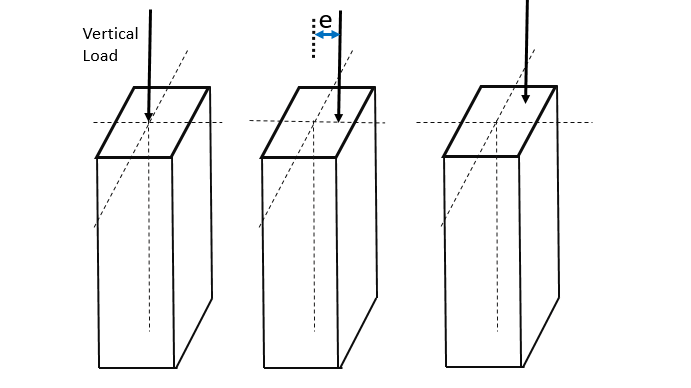
Axially Loaded Column
If the vertical compressive load passes exactly through the centroid of the column cross-section, it is termed an axially loaded column. In ideal conditions, no bending moment develops. However, in practical construction, perfect axial loading rarely occurs due to unavoidable eccentricity.
Eccentrically Loaded Column: Uniaxial
When the load acts at a distance ‘e’ from the centroid along either the x-axis or y-axis, the column experiences uniaxial bending along with axial compression. The resulting stress distribution becomes non-uniform across the section.
Eccentrically Loaded Column: Biaxial
When the load is applied away from both principal axes, bending occurs simultaneously about both x and y directions. Biaxial bending commonly occurs in corner columns and edge columns of multistorey buildings subjected to lateral forces.
Classification of Column Based on Column Ties
Tied Column
In tied columns, longitudinal reinforcement bars are enclosed by lateral ties at regular spacing. These ties:
- Prevent buckling of longitudinal reinforcement
- Provide confinement to concrete core
- Maintain position of reinforcement during concreting
Tied columns are commonly used in low and medium seismic regions.
Spiral Column
In spiral columns, a continuous helical reinforcement replaces lateral ties. Spiral reinforcement provides improved confinement, ductility, and energy dissipation capacity, making it suitable for seismic design and heavily loaded structures.
Classification of Column Based on Slenderness
Short Compression Block or Pedestal
A pedestal is a compression member whose unsupported height is less than three times its least lateral dimension. It primarily transfers compressive load and is often used between footing and column.
Short Reinforced Column
If the slenderness ratio (effective length divided by least lateral dimension) is less than 12, the member is classified as a short column. Failure generally occurs by material crushing rather than buckling.
Long Reinforced Column
If the slenderness ratio exceeds 12, the column behaves as a slender column. Additional bending due to buckling (secondary moment or P–Δ effect) must be considered in design.
Classification of Column Based on Shape of Cross Section
Geometric Shaped Columns
Columns may be rectangular, square, circular, hexagonal, or octagonal. Rectangular and square sections are widely used in buildings due to ease of formwork. Circular columns provide uniform stress distribution and are commonly used in bridges and architectural structures.
L-Shaped Column
L-shaped columns are generally used at building corners. They efficiently resist biaxial bending and are suitable where architectural constraints exist.
V-Shaped Column
V-shaped columns are used in special structural systems and architectural designs. They require detailed analysis due to inclined load transfer mechanism.
T-Shaped Column
T-shaped columns are used in special structural configurations such as bridge piers and retaining structures where asymmetric loading occurs.
Classification of Column Based on Construction Materials
Reinforced Concrete Column
Reinforced concrete columns are widely used in framed buildings. Concrete resists compression while steel reinforcement provides tensile strength and ductility.
Composite Column
Composite columns consist of structural steel sections encased in or filled with concrete. They provide higher strength-to-size ratio, improved stiffness, and enhanced fire resistance.
Steel, Timber, Brick Column
Steel columns are common in industrial buildings and long-span structures. Timber columns are used in residential and low-rise construction. Brick columns are used in masonry structures and may include reinforcement for additional strength.
Classification of Column Based on Frame Bracing
Braced Column
In braced frames, lateral loads are resisted by shear walls or bracing systems. Columns mainly carry axial loads, and their effective length is reduced.
Unbraced Column
In unbraced frames, columns resist both gravity and lateral loads. The effective length increases, reducing axial load capacity and increasing bending effects.
Some Other Types of Column
Prestressed Concrete Column
Prestressed columns are used where high axial load and bending exist. Prestressing improves crack control, stiffness, and load-carrying capacity.
Greek and Roman Column
Classical columns such as Doric, Ionic, Corinthian, and Tuscan are architectural elements originating from ancient civilizations. Although primarily aesthetic, they may also serve structural functions in monumental construction.
Conclusion
Columns are fundamental vertical compression members in structural systems. Proper classification based on loading, slenderness, reinforcement detailing, material, and frame stability is essential for safe and economical structural design. Understanding different types of columns is important for civil engineering students in examinations and for practicing engineers in real-life structural analysis and design.