

In many construction projects, the in situ sandy soil is found to be loose and incapable of supporting structural loads safely. Loose sand exhibits low relative density, low shear strength, high compressibility, and excessive settlement under loading. In saturated conditions, it may also be susceptible to liquefaction during earthquakes. For these reasons, sandy soil often requires improvement before the construction of buildings, highways, embankments, dams, and industrial foundations.
Sandy soil improvement refers to the process of increasing the density, strength, stiffness, and bearing capacity of sandy deposits through mechanical, chemical, or grouting techniques. The primary objective is to reduce settlement, increase load-carrying capacity, and improve overall stability.
In this article, different ground improvement methods for sandy soil are discussed in detail, along with their suitability, depth range, and engineering applications.
Engineering Problems of Sandy Soil in Construction
Before selecting a stabilization method, it is important to understand the major engineering problems associated with sandy soil:
- Low Bearing Capacity: Loose sand has low relative density, resulting in reduced shear strength.
- Excessive Settlement: Elastic and immediate settlements are significant under structural loads.
- Liquefaction Risk: Saturated loose sand may lose strength during seismic shaking.
- High Permeability: Rapid drainage may cause piping and erosion issues.
- Low Cohesion: Sand particles lack bonding unless stabilized.
Objectives of Sandy Soil Improvement
The main objectives from a geotechnical engineering perspective are:
- Increase relative density
- Improve shear strength parameters (ϕ angle)
- Increase bearing capacity
- Reduce compressibility
- Mitigate liquefaction potential
- Decrease permeability when required
Sandy Soil Improvement Methods
The followings are the methods to improve sandy soil.
- Field Compaction
- Vibroflotation
- Blasting
- Cement Stabilization
- Fly Ash Stabilization
- Dynamic Compaction
- Jet Grouting
Field Compaction
Ordinary compaction in the field is done by rollers. The most commonly used rollers for sandy soil are the following.
- Smooth Wheel Roller
- Pneumatic Rubber-Tired Rollers
- Vibratory Rollers
A brief description of field compaction with these three types of rollers is given below.
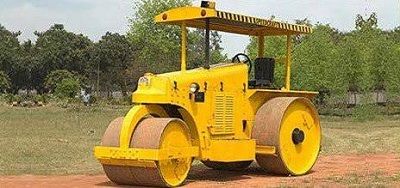
Smooth Wheel Roller
It can create vertical vibrations during compaction. Smooth wheel rollers are suitable for proof-rolling subgrades and for finishing the construction of fills with sandy soils. They provide 100% coverage under the wheels. The contact pressure can be as high as 300 to 400 KN/m2. However, they do not produce a uniform weight of compaction when used on thick layers.
Pneumatic Rubber-Tired Rollers
They are better in many respects than smooth wheel rollers. Pneumatic rollers, which may weigh as much as 2000 KN, consist of a heavily loaded wagon with several rows of tires. The tires are closely spaced- four to six in a row. The contact pressure under the tires may range from 600 to 700 KN/m2, and they give about 70 to 80% coverage. Pneumatic rollers, which can be used for sandy soil compaction, produce a combination of pressure and kneading action.

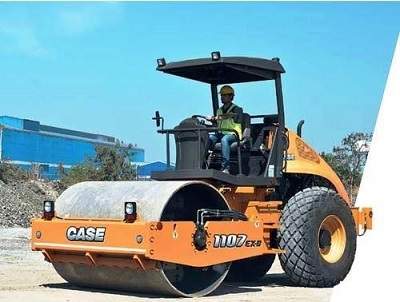
Vibratory Rollers
They are efficient in compacting granular soils. Vibrators can be attached to the smooth wheel, pneumatic rubber-tired, or sheepsfoot rollers to send vibrations into the soil being compacted.
In general, compaction in the field depends on several factors. Such as the type of compactor, type of soil, moisture content, lift thickness, towing speed of the compactor, and the number of passes the roller makes.
Vibroflotation
Vibroflotation is a technique developed for in situ densification of thick layers of loose granular soil deposits. The process involves the use of a vibroflot (called the vibrating unit). The device is about 2 m in length. This vibrating unit has an eccentric weight inside. It can develop a centrifugal force. The weight enables the unit to vibrate horizontally. The openings at the bottom and top of the unit are for water jets. The vibrating unit is attached to a follow-up pipe.
The entire compaction process can be divided into four steps.
Step 1. The jet at the bottom of the vibroflot is turned on. The vibroflot is lowered into the ground.
Step 2. The water jet creates a quick condition in the soil. Which allows the vibrating unit to sink.
Step 3. Granular material is poured into the top of the hole. The water from the lower jet is transferred to the jet at the top of the vibrating unit. This water carries the granular material down the hole.
Step 4. The vibrating unit gradually raised in about 0.3 m lifts. It is held vibrating for about 30 seconds at a time. This process compacts the soil to the desired unit weight.
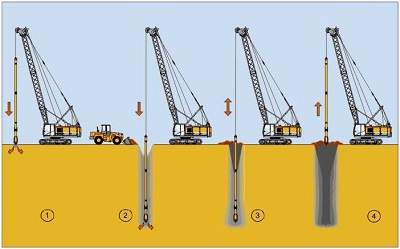
The success of the densification of in situ soil depends on several factors, the most important of which are the grain size distribution of the soil and the nature of the backfill used to fill the holes during the withdrawal period of the vibroflot.
Blasting
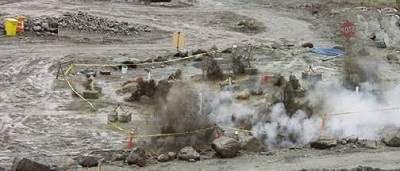
Blasting is a technique that has been used successfully in many projects for the densification of granular soils. The general soil grain sizes suitable for compaction by blasting are the same as those for compaction by vibroflotation.
The process involves the detonation of explosive charges such as 60% dynamite at a certain depth below the ground surface in saturated soil. The lateral spacing of the charges varies from about 3 to 9 m. Three to five successful detonations are usually necessary to achieve the desired compaction.
Compaction (up to a relative density of about 80%) up to a depth of about 18 m over a large area can easily be achieved by using this process. Usually, the explosive charges are placed at a depth of about two-thirds of the thickness of the soil layer desired to be compacted.
Read more: Blasting - A Technique for Soil Improvement
Cement Stabilization
Cement is being increasingly used as a stabilizing material for soil. It is particularly used in the construction of highways and earth dams. Cement can be used to stabilize both sandy and clayey soils. As in the case of lime, cement helps decrease the liquid limit and increase the plasticity index and workability of clayey soils. Cement stabilization is effective for clayey soils when the liquid limit is less than 45 to 50 and the plasticity index is less than about 25.
Like lime, cement helps increase the strength of soils. The strength increases with the curing time.
Granular soils and clayey soils with low plasticity obviously are most suitable for cement stabilization. Calcium clays are more easily stabilized by the addition of cement. On the other hand, Sodium and hydrogen clays, which are expansive in nature, respond better to lime stabilization. For these reasons, proper care should be given in the selection of the stabilizing material. For field compaction, the proper amount of cement can be mixed with soil either at the site or at a mixing plant. If the latter approach is adopted, the mixture can then be carried to the site. The soil is compacted to the required unit weight with a predetermined amount of water.
Similar to lime injection, cement slurry made of Portland cement and water can be used for pressure grouting of poor soils under the foundations of buildings and other structures. The water-cement ratio could be of 0.5:5. Grouting decreases the hydraulic conductivity of soils. It increases their strength and load-bearing capacity. For the design of low-frequency machine foundations subjected to vibrating forces, stiffening the foundation soil by grouting and thereby increasing the resonant frequency is sometimes necessary.
Fly Ash Stabilization
Fly ash is a by-product of the pulverized coal combustion process usually associated with electric power-generating plants. It is fine-grained dust. It is composed primarily of silica, alumina, and various oxides and alkalis. Fly ash is pozzolanic in nature. It can react with hydrated lime to produce cementitious products. For that reason, lime–fly-ash mixtures can be used to stabilize highway bases and subbases. Effective mixes can be prepared with 10 to 35% fly ash and 2 to 10% lime. Soil–lime–fly-ash mixes are compacted under controlled conditions, with proper amounts of moisture to obtain stabilized soil layers.
Dynamic Compaction
Dynamic compaction is a technique that is beginning to gain popularity in the United States for the densification of granular soil deposits. The process primarily involves dropping a heavyweight repeatedly on the ground at regular intervals. The weight of the hammer used varies from 8 to 35 metric tons, and the height of the hammer drop varies between 7.5 and 30.5 m.
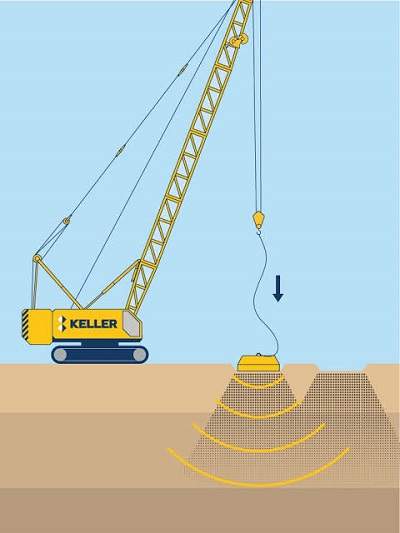
The stress waves generated by the hammer drops help in the densification. The degree of compaction achieved depends on
- The weight of the hammer
- The height of the drop
- The spacing of the locations at which the hammer is dropped
Jet Grouting
Jet grouting is a soil stabilization process whereby a cement slurry is injected into the soil at a high velocity to form a soil–concrete matrix.
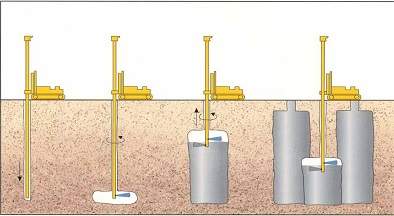
Three basic systems of jet grouting have been developed—single, double, and triple rod systems. In all cases, hydraulic rotary drilling is used to reach the design
depth at which the soil has to be stabilized.
The effectiveness of jet grouting is very much influenced by the nature of erodibility of soil. Gravelly soil and clean sand are highly erodible, whereas highly plastic clays are difficult to erode.
Liquefaction Mitigation in Sandy Soil
Loose saturated sand is highly susceptible to liquefaction during earthquakes. Methods like vibroflotation, dynamic compaction, and stone columns significantly increase relative density and reduce pore water pressure generation.
Improvement is generally verified using Standard Penetration Test (SPT N-values) or Cone Penetration Test (CPT).
Comparison of Sandy Soil Improvement Methods
| Method | Effective Depth | Best For |
|---|---|---|
| Field Compaction | 0–3 m | Shallow fills |
| Vibroflotation | Up to 20 m | Deep loose sand |
| Dynamic Compaction | Up to 10–12 m | Loose fills |
| Jet Grouting | Variable | High-strength columns |
Conclusion
Sandy soil improvement is essential for ensuring safe and economical foundation performance. The selection of an appropriate method depends on depth, groundwater condition, grain size distribution, project type, and required performance. Mechanical densification methods such as vibratory compaction and dynamic compaction are economical for large areas, while chemical stabilization and grouting methods are suitable for localized strengthening.
Proper site investigation and field testing must be carried out before and after improvement to verify design assumptions and performance.
Sand Articles
- What is sand? Composition, Color, and Types of Sand
- Uses of sand
- What is Sandy Soil?- Uses of Sandy Soil
- How to Improve Sandy Soil
- What is the Bulking of Sand? - Significance & Test Steps
- What is Silica Sand? Sources & Uses of Silica Sand
- Types of Silica Sand
- The Health Risks of Silica Sand
- Bulk Density of Sand
- Specific Gravity of Sand
- Sand Unit Weight
References
- Das, B. M. (2011). Principles of foundation engineering(7th ed.). Boston, MA: Cengage Learning.
- Bowles, J. E. (1984). Physical and geotechnical properties of soils(2nd ed.). New York: McGraw-Hill.
- https://www.designingbuildings.co.uk/wiki/Types_of_roller
- https://www.forconstructionpros.com/asphalt/article/10616882/clearing-the-air-about-pneumatic-rollers
- https://www.indiamart.com/proddetail/case-double-drum-vibratory-roller-4965269662.html
- https://www.geoengineer.org/education/web-class-projects/cee-542-soil-site-improve-winter-2014/assignments/vibroflotation
- https://civildigital.com/blasting-technique-for-ground-improvement/
- https://www.keller.co.uk/expertise/techniques/dynamic-compaction
- https://research.engineering.ucdavis.edu/gpa/ground-improvement/jet-grouting/