

Blasting has been successfully used in many projects for soil improvement. This method, also known as explosive compaction, uses buried, time-delayed explosive charges to densify loose granular soils.
The primary objective of blasting is to increase the relative density of loose sands and gravels and thereby improve bearing capacity and reduce settlement.
Suitable Soil Conditions for Blasting
This technique is effective mainly in cohesionless soils such as loose sands and gravels.
- Maximum 15% of particles passing No. 200 sieve.
- Maximum 3% passing 0.005 mm size.
- Soil should preferably be fully saturated.
The moisture condition is critical. In partially saturated soils, surface tension forces reduce the effectiveness of blasting. In some cases, pre-wetting of the site is required by constructing a temporary dyke and reservoir system to ensure saturation.
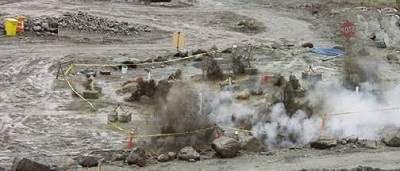
Mechanism of Explosive Soil Densification
The process involves detonation of explosive charges (commonly 60% dynamite) at a specific depth below the ground surface in saturated soil.
When the charge detonates:
- Shock waves propagate outward.
- Pore water pressure increases temporarily.
- Soil particles rearrange into a denser configuration.
- Excess pore water pressure dissipates, resulting in permanent densification.
Theoretically, each explosive charge densifies the surrounding and underlying soil without significantly lifting the soil mass above the blast.
Blasting Procedure and Design Parameters
Key design parameters include:
- Lateral spacing: Typically 3–9 m between charges.
- Depth of charge: About two-thirds of the thickness of the soil layer to be compacted.
- Number of detonations: Usually 3–5 sequences are required.
- Maximum effective depth: Up to approximately 18 m.
- Achievable relative density: Up to about 80%.
Charge delays must be carefully timed to achieve uniform densification from bottom to top. Improper timing may cause uneven compaction.
The uppermost soil layer is often loosened after blasting. This loosened layer is subsequently compacted using vibratory rollers.
Advantages and Limitations of Blasting for Soil Improvement
Advantages:
- Effective for deep densification.
- Suitable for large project areas.
- Can treat depths up to 18 m.
Limitations:
- Not suitable for cohesive soils.
- Requires careful safety control.
- May cause ground vibration affecting nearby structures.
- Pre-wetting may be necessary.
Blasting is generally considered where other densification techniques such as vibro-compaction or dynamic compaction are impractical.
References
- Das, B. M. (2011). Principles of Foundation Engineering (7th ed.). Cengage Learning.
- Bowles, J. E. (1984). Physical and Geotechnical Properties of Soils (2nd ed.). McGraw-Hill.
- Murthy, V.N.S. (1974). Principles of Soil Mechanics and Foundation Engineering (5th ed.). UBSPD.