

Boussinesq (1842–1929) developed equations that can be used to determine the stress at any point P at a depth z, caused by a surface point load.
This is one of the most widely used solutions in geotechnical engineering for estimating how stress spreads through soil beneath a foundation, footing, or any concentrated surface load. Since soil behaves approximately as an elastic, homogeneous, and isotropic medium under working loads, Boussinesq's theory gives engineers a practical way to estimate the increase in vertical stress at any depth without resorting to complex numerical analysis.
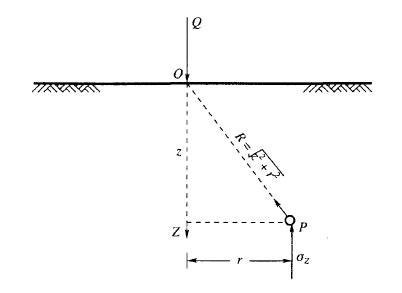
Boussinesq's Formula
At point P in the figure above, due to a point load Q,
\[Vertical\hspace{.2cm}{stress}, \sigma_{z}=\frac{3Q}{2\pi{z^{2}}}\frac{1}{[1+(r/z)^{2}]^{5/2}}=\frac{Q}{z^{2}}I_{B}\]
where,
r = the horizontal distance between the point P (below the surface) and the vertical axis through the point load Q.
z = the vertical depth of point P below the surface.
IB = Boussinesq's stress coefficient = \[\frac{3}{2\pi}\frac{1}{[1+(r/z)^{2}]^{5/2}}\]
Key Points to Note
1. The stress σz is maximum directly below the point load (i.e., when r = 0) and decreases as the horizontal distance r increases.
2. For a fixed value of r/z, the coefficient IB remains constant — this allows IB values to be tabulated or plotted for quick use in design calculations.
3. The theory assumes a single, isolated point load. For distributed loads (like a footing), the stress is found by dividing the loaded area into small elements and integrating the point load solution over the entire area, or by using established charts (e.g., Newmark's influence chart) derived from this same equation.
References
- "Principles and Practices of Soil Mechanics and Foundation Engineering" by V.N.S. Murthy
- Craig's Soil Mechanics by R.F. Craig
While Boussinesq's equation is a powerful tool, it is based on several simplifying assumptions about the soil medium that don't always hold true in the field. Understanding these assumptions is important for knowing when and how much to trust the results — see the related article below for details.
Related Article