

In this article, we will discuss what is a shallow foundation along with different types of shallow foundations.
What is a Shallow Foundation?
A shallow foundation is a type of foundation that transfers building loads to the earth very near the ground surface, rather than to deeper soil or rock layers. Generally, when the depth of foundation is less than or equal to its width, it is classified as a shallow foundation.
Shallow foundations are typically used for small to medium structures such as residential buildings, garages, and low-rise commercial buildings. The soil below shallow foundations is usually prepared by leveling and compaction, but no deep excavation is required.
Shallow foundations are usually more economical than deep foundations because they require less excavation, less reinforcement, and simpler construction procedures. However, they are suitable only when the soil near the surface has adequate bearing capacity and limited settlement characteristics.
Different Types of Shallow Foundations
Shallow foundations are classified based on load transfer mechanism, arrangement of columns or walls, and soil conditions. The common types are:
- Individual Footing or Isolated Footing
- Wall Footing or Strip Footing (Continuous Footing)
- Combined Footing
- Cantilever or Strap Footing
- Raft or Mat Foundation
Isolated Spread Footing or Individual Footing
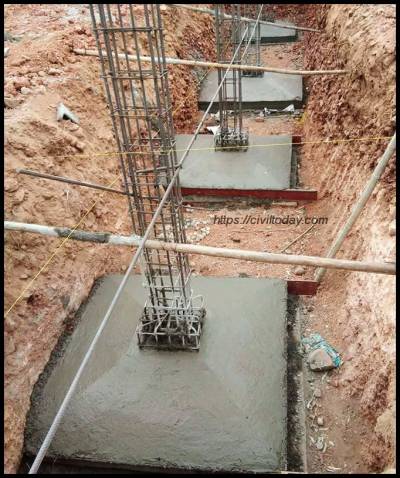
It is the most commonly used type of shallow foundation. An isolated footing supports a single column or pier. It is also known as column footing, pier footing, or pedestal footing.
It is generally square or rectangular in shape and constructed using reinforced concrete. Reinforcement is provided to resist bending moments developed due to soil pressure. This type of footing is suitable when columns are spaced apart and soil bearing capacity is adequate.
Combined Footing
Combined footing is provided when two or more columns are close to each other and their individual footings overlap. It is also used when a column is located near the property line and cannot have a symmetrical footing.
The combined footing is usually rectangular or trapezoidal in shape. It helps in uniform distribution of load to the soil and prevents eccentric loading conditions.
Wall Footing or Strip Footing or Continuous Footing
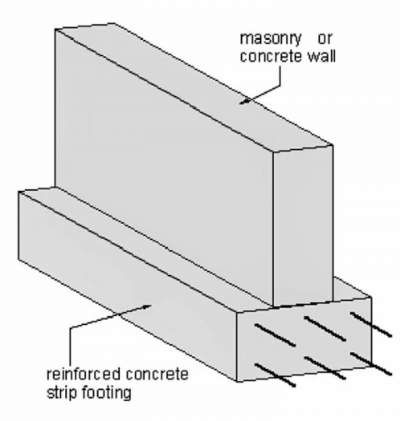
Strip footing is provided under load-bearing walls or a row of closely spaced columns. It runs continuously along the length of the wall.
This type of footing spreads the load over a larger area and reduces the pressure on soil. Strip footing is commonly used in masonry structures and low-rise buildings.
Cantilever or Strap Footing
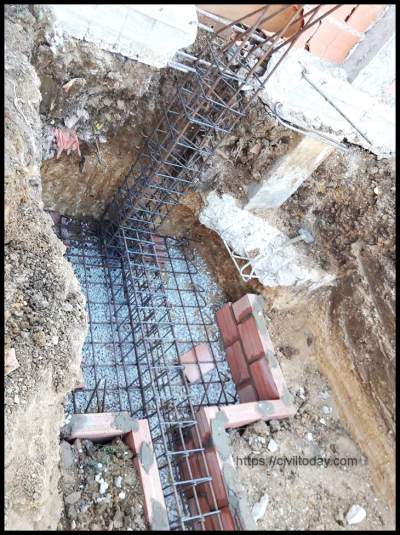
A strap footing is a special type of combined footing where two isolated footings are connected by a strap beam. The strap beam does not transfer load to soil directly but helps in balancing eccentric loads.
This type of foundation is useful when one column is near the boundary and symmetrical footing cannot be provided.
Raft or Mat Foundation
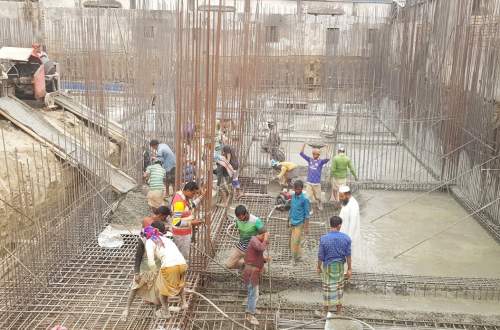
A raft or mat foundation consists of a large reinforced concrete slab covering the entire footprint of the building. It supports multiple columns and walls together.
Raft foundations are used where soil bearing capacity is low and individual footings would occupy more than 50% of the building area. The mat distributes the load uniformly and reduces differential settlement.
Conclusion
Shallow foundations are economical and widely used when surface soil has adequate bearing capacity. Proper selection of footing type depends on structural load, column arrangement, and soil characteristics. Correct design ensures safety, stability, and minimum settlement of the structure.