

Foundations provide support to a structure and transfer its loads to the soil. However, the layer to which the foundation transfers the load must have adequate bearing capacity and suitable settlement characteristics. There are several types of foundations, and the choice depends on considerations such as:
- Total load from the superstructure.
- Soil conditions.
- Water table level.
- Sensitivity to noise and vibrations.
- Available resources.
- The time frame of the project.
- Cost.
Broadly speaking, foundations can be classified as shallow foundations and deep foundations. Shallow footings are typically used when the bearing capacity of the surface soil is adequate to carry the loads imposed by a structure. Deep foundations, on the other hand, are used when the surface soil's bearing capacity is insufficient, so the loads must be transferred to a deeper layer with higher bearing capacity. A pile foundation is one type of deep foundation, and it is one of the most widely used solutions in foundation engineering. In this article, we discuss what a pile foundation is and the different types of pile foundations used in construction.
What is a Pile Foundation?
A pile foundation, a type of deep foundation, can be defined as a slender column or long cylinder made of materials such as concrete or steel, used to support a structure and transfer its load to a desired depth either by end bearing or skin friction.
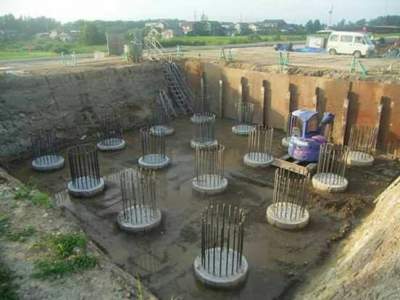
Pile foundations are deep foundations. They are formed by long, slender, columnar elements typically made from steel or reinforced concrete, or sometimes timber. A foundation is described as 'piled' when its depth is more than three times its breadth.
Pile foundations are usually used for large structures and in situations where the soil at shallow depth is not suitable to resist excessive settlement, resist uplift, etc.
When to Use a Pile Foundation
A common question among engineers is when a pile foundation is the right choice. The following are situations where using a pile foundation system can be beneficial:
- When the groundwater table is high, pile foundations are usually the best solution.
- When heavy or non-uniform loads are imposed by the superstructure.
- When other types of foundations are costlier or not feasible.
- When the soil at shallow depth is compressible.
- When there is a possibility of scouring, due to the structure's location near a riverbed or seashore, etc.
- When there is a canal or deep drainage system near the structure.
- When soil excavation to the desired depth is not possible due to poor soil conditions.
- When it becomes impossible to keep foundation trenches dry by pumping or other measures, due to heavy seepage inflow.
Whenever one of the above conditions applies, the foundation engineer must select the most suitable option among the different types of pile foundations.
Types of Pile Foundations
Pile foundations can be classified based on function, materials, installation process, etc. The following are the main types of pile foundations used in construction:
- Based on Function or Use
- Based on Materials and Construction Method
- Timber Piles
- Concrete Piles
- Steel Piles
- Composite Piles
The following diagram represents the different types of piles discussed above.
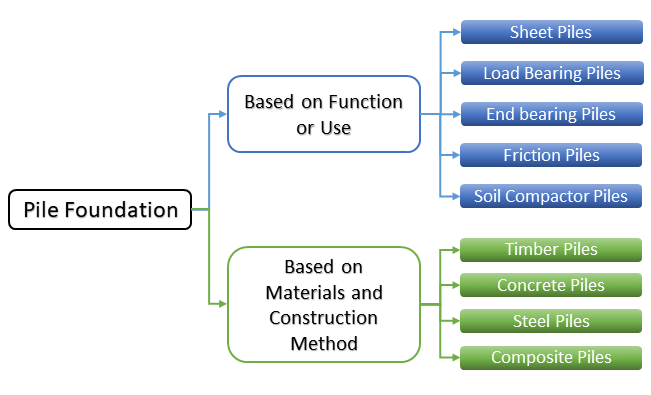
These pile foundation types are briefly discussed below.
Classification of Pile Foundation Based on Function or Use
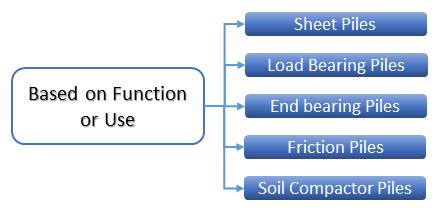
As shown in the diagram below, there are five pile types based on their use and function.
Sheet Piles
This type of pile is mainly used to provide lateral support, resisting lateral pressure from loose soil, water flow, etc. They are commonly used for cofferdams, trench sheeting, shore protection, and similar applications, and are not intended to provide vertical support to a structure. Sheet piles are typically used to:
- Construct retaining walls.
- Protect against riverbank erosion.
- Retain loose soil around foundation trenches.
- Isolate the foundation from adjacent soils.
- Confine the soil and thereby increase its bearing capacity.
Load Bearing Piles
This type of pile is mainly used to transfer vertical loads from the structure to the soil. Load-bearing piles carry loads through soil with poor supporting properties down to a layer capable of bearing the load. Depending on the mechanism of load transfer from the pile to the soil, load-bearing piles can be further classified as follows.
End Bearing Piles
In this type of pile foundation, loads are transferred through the lower tip of the pile. The bottom of the end-bearing pile rests on a strong layer of soil or rock, usually at the transition between a weak layer and a strong layer. As a result, the pile acts like a column, safely transferring the load to the strong layer below.
The total capacity of an end-bearing pile foundation is calculated by multiplying the cross-sectional area of the pile tip by the bearing capacity of the soil at that depth. Applying a reasonable factor of safety, the required diameter of the pile can then be determined.
Friction Pile
A friction pile transfers load from the structure to the soil through the frictional force between the surface of the pile and the surrounding soil, such as stiff clay or sandy soil. This friction can develop along the entire length of the pile or over a defined portion of it, depending on the soil strata. In most friction piles, the entire surface area of the pile contributes to transferring load to the soil.
The capacity of the pile is determined by multiplying its surface area by the safe frictional resistance developed per unit area.
When designing a friction pile, the skin friction expected at the pile surface should be carefully evaluated, with a reasonable factor of safety applied. Capacity can also be increased by enlarging the pile diameter, increasing its depth, adding more piles, or roughening the pile surface.
Soil Compactor Piles
Unlike other pile types, soil compactor piles do not carry any direct load. Instead, they are driven and placed at close intervals to increase the bearing capacity of the surrounding soil through compaction.
Types of Piles Based on Materials and Construction Method
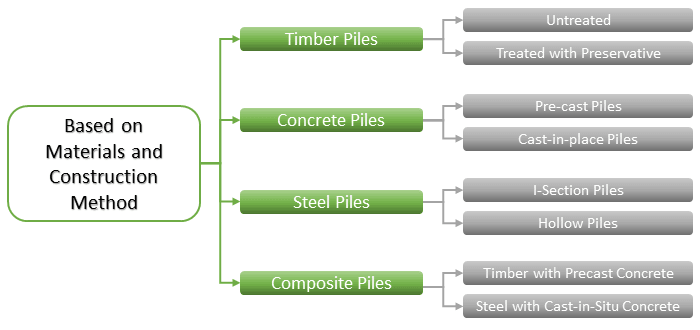
Piles can be broadly classified into two categories: displacement piles and non-displacement (or replacement) piles. Displacement piles push soil aside — both vertically and radially — as they are driven into the ground. With replacement piles, the ground is bored and the soil removed, and the resulting hole is then either filled with concrete or fitted with a precast concrete pile. Based on their material and construction method, piles can be classified as follows:
- Timber Piles
- Untreated
- Treated with Preservative
- Concrete Piles
- Pre-cast Piles
- Cast-in-place Piles
- Steel Piles
- I-Section Piles
- Hollow Piles
- Composite Piles
Timber Piles
Timber piles are typically used below the water table and last approximately 30 years. They can be rectangular or circular in cross-section, with diameters ranging from 12 to 16 inches. The length of the pile is usually about 20 times its top width.
They are generally designed to carry 15 to 20 tons, and additional strength can be achieved by bolting fish plates to the sides of the piles.
Advantages of Timber Piles
- Available in regular, standard sizes.
- Economical.
- Easy to install.
- Low risk of damage during installation.
- Can be cut to the desired length after installation.
- Can be easily extracted if necessary.
Disadvantages of Timber Piles
- Longer lengths are not always readily available.
- Straight piles are difficult to source in shorter lengths.
- Difficult to drive into very hard soil strata.
- Splicing timber piles is difficult.
- Not suitable for use as end-bearing piles.
- Require special treatment (such as preservatives) for durability.
Concrete Piles
Pre-cast Concrete Pile
A precast concrete pile is cast in a pile bed — in horizontal form if rectangular, or in vertical form if circular. Precast piles are usually reinforced with steel to prevent breakage while being moved from the casting bed to the foundation location. After casting, the piles are cured according to specification, typically for 21 to 28 days.
Advantages of Pre-cast Piles
- High resistance to chemical and biological degradation.
- Generally high strength.
- A central pipe can be installed to facilitate driving.
- Piles cast in advance can speed up the installation phase.
- Reinforcement confinement can be ensured during casting.
- Quality can be closely controlled.
- Faulty piles can be identified and replaced before driving.
- Can be driven underwater.
- Can be loaded immediately after being driven to the required depth.
Disadvantages of Pre-cast Piles
- Once cast, the pile length is difficult to increase or decrease.
- Difficult to mobilize and transport.
- Requires heavy, expensive equipment to drive.
- Not available off-the-shelf, which can delay projects.
- Risk of breakage or damage during handling and driving.
Cast-in-Place Concrete Piles
This type of pile is constructed by boring the soil to the desired depth, then depositing freshly mixed concrete into the hole and allowing it to cure in place. A cast-in-situ pile is typically formed either by driving a metal shell into the ground and filling it with concrete and leaving the shell in place, or by pouring concrete as the shell is gradually withdrawn. Round piles are the most common shape used in this method.
Advantages of Cast-in-Place Concrete Piles
- Shells are lightweight and easy to handle.
- Pile length can be adjusted easily.
- Shells can be assembled on site.
- Little extra reinforcement is needed, mainly just to prevent handling damage.
- No risk of breakage during installation.
- Additional piles can be added easily if required.
Disadvantages of Cast-in-Place Concrete Piles
- Installation requires careful supervision and quality control.
- Requires sufficient on-site space for material storage.
- Difficult to construct where groundwater flow is heavy.
- The base of the pile may not be perfectly symmetrical.
- Unreinforced, uncased piles can fail in tension under uplift forces.
Steel Piles
Steel piles may be I-sections or hollow pipes, sometimes filled with concrete. Diameters typically range from 10 to 24 inches, with a wall thickness of about ¾ inch. Their relatively small cross-sectional area makes them easy to drive, and they are most commonly used as end-bearing piles.
Advantages of Steel Piles
- Easy to install.
- Can reach greater depths than most other pile types.
- Can penetrate hard soil layers due to their small cross-sectional area.
- Easy to splice.
- Can carry heavy loads.
Disadvantages of Steel Piles
- Prone to corrosion.
- Risk of deviation during driving.
- Comparatively expensive.
Pile Foundation Articles
- What is Pile Foundation? Types of Pile Foundation
- Uses of Pile Foundation
- Pile foundation advantages and disadvantages
- Factors Affecting Selection of Pile Foundation Type
- Causes of Pile Foundation Failure
- Difference Between Shallow and Deep Foundation
- What is Friction Pile? Capacity Calculation & Details
- Differences Between Pile and Pier Foundation
- Difference Between Piles, Piers, and Caissons