

A Pier Foundation is a type of deep foundation mainly used for bridges, dams, and other heavy structures. It is also widely used in tall buildings and residential houses built on weak or unstable soil. In this article, we will discuss what a pier foundation is, its types, advantages, construction details, and suitable conditions for its use.
What is a Pier Foundation?
A pier foundation consists of large-diameter cylindrical columns constructed below the ground to support the superstructure and transfer heavy loads to firm soil strata or rock.
The pier transfers structural loads safely to the underlying soil or rock layer. It is generally constructed by excavating a hole and filling it with concrete, stone, or reinforced materials.
Pier foundations are also known as post foundations or column foundations. They are especially suitable where shallow foundations are not feasible due to low bearing capacity soil.
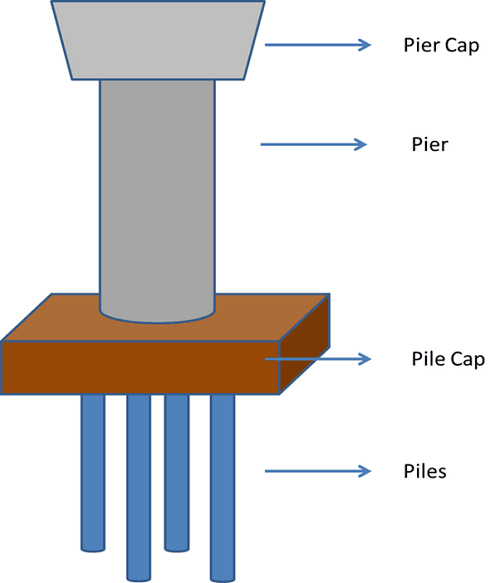
Types of Pier Foundation
Based on Materials Used:
- Masonry Piers
- Concrete Piers
- Drilled Caissons (Drilled Piers)
- Timber Piers
- Steel Piers
Based on Structural Configuration:
- Beam and Girder Piers
- Column and Cap Piers
- Slab Piers
- Pile Piers
Masonry Piers
Masonry piers are constructed using brick, stone, or concrete blocks. They are durable and economical for residential buildings. However, they are suitable only where soil bearing capacity is moderate to high.
Concrete Piers
Concrete piers are widely used due to their high compressive strength and durability. They can be plain or reinforced. Reinforced concrete piers provide higher structural capacity and better crack resistance.
Timber Piers
Timber piers are constructed from pressure-treated wood. They are generally used for lightweight structures. Although economical, they are vulnerable to decay and insect attack.
Steel Piers
Steel piers are driven into the ground until they reach stable strata. They are suitable for heavy structures and for underpinning existing foundations. Steel piers perform well in soft or expansive soils.
Drilled Caissons (Drilled Piers)
Drilled caissons are cylindrical deep foundations constructed by drilling a hole and filling it with reinforced concrete. They may have enlarged bases to increase load-bearing capacity. They are widely used in bridge and high-rise construction.
Advantages of Pier Foundation
- Requires less excavation compared to full basement foundations.
- Economical in terms of materials and labor.
- Minimal disturbance to surrounding soil.
- Suitable for sloping sites and uneven terrain.
- Reduces flood risk by elevating the structure above ground.
- Provides easy access to plumbing and utility installations.
- No ground vibration in case of drilled piers.
- Bearing capacity can be increased by under-reaming.
- Inspection and maintenance are relatively easier.
- Flexible in design modification.
Pier Foundation Construction Details
Spacing of Piers
Piers are typically spaced depending on structural load and design requirements. In residential buildings, spacing usually ranges from 6 to 10 feet center-to-center. The plinth level is generally kept 1–1.5 feet above ground to prevent moisture damage.
Shape and Size
- Square
- Rectangular
- Circular
Common diameters are 6", 8", 10", and 16". Depth depends on soil condition and must extend below frost depth, generally 5–6 ft or more.
Materials Used
The most common material used is reinforced concrete due to its high compressive strength, durability, and resistance to environmental effects. Brick, stone, timber, and steel may also be used depending on project requirements.
Types of Cross-Section
Cross-sections may be cylindrical, square, or under-reamed. Under-reamed piers have enlarged bases to increase load-bearing capacity and reduce settlement.
Construction Technology
Construction generally involves:
- Excavation of borehole
- Placement of formwork (if required)
- Installation of reinforcement cage
- Pouring and curing of concrete
Modern bored pile techniques reduce earthwork and improve construction speed.
Grillage
The top structural element connecting individual piers is called grillage. It distributes loads from columns or beams evenly to the piers. Grillage foundations are economical for low-bearing-capacity soils.
Suitable Conditions for Pier Foundation
- When decomposed rock overlies sound rock.
- In stiff clay where pile driving is difficult.
- For lightweight timber or framed houses.
- On sloping ground.
- Where shallow foundations are not feasible.
Conclusion
Pier foundations are economical and efficient deep foundation systems for transferring structural loads to firm strata. They are widely used in bridges, buildings, and marine structures. With proper design and construction, pier foundations provide long-term stability and durability even in challenging soil conditions.