

In the 1980s, the construction industry in Japan faced a shortage of skilled labor. Poor compaction and defective workmanship began affecting concrete durability and strength. To solve this problem, a new type of concrete capable of compacting under its own weight was developed — Self-Compacting Concrete (SCC).
The development of SCC is largely credited to Prof. Dr. Hajime Okamura of the University of Tokyo. Research led by Okamura and Ozawa in 1988 resulted in a practical version of highly flowable, non-segregating concrete. Initially referred to as High-Performance Concrete, it later became known as Self-Compacting Concrete (SCC).
What is Self-Compacting Concrete?
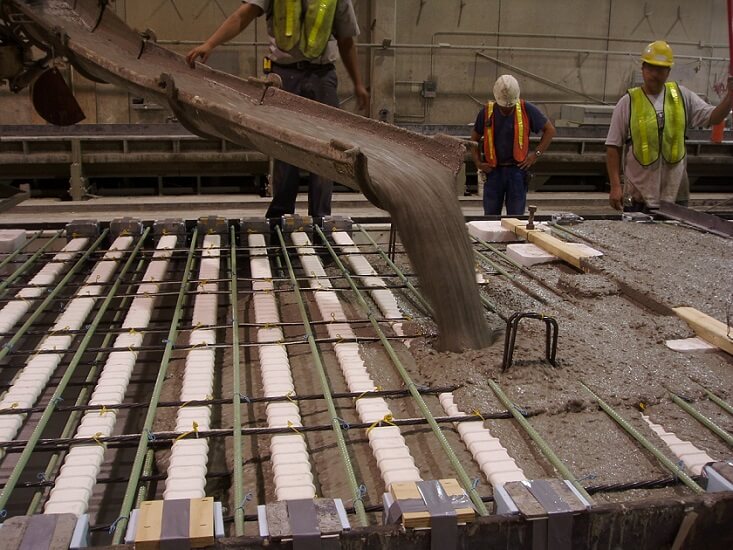
Self-Compacting Concrete (SCC), also known as Self-Consolidating Concrete, is a highly flowable, deformable, and non-segregating concrete that spreads into formwork and completely fills it under its own weight without mechanical vibration.
Flowability is achieved by using high-range water-reducing admixtures (superplasticizers). Stability against segregation is ensured by increasing fines content and sometimes adding viscosity-modifying admixtures (VMA).
Self-Compactability = High Flowability + High Segregation Resistance
Fundamental Principles of SCC
In conventional concrete, vibration is required to remove entrapped air and achieve compaction. However, in structures with congested reinforcement, vibration becomes difficult, leading to honeycombing and voids.
SCC overcomes this by balancing two conflicting properties:
- High Deformability: Ability to flow easily.
- High Stability: Resistance to segregation and bleeding.
This balance is achieved by:
- Reducing coarse aggregate content
- Increasing powder content (cement + mineral admixtures)
- Using superplasticizers
- Using viscosity modifying agents (if required)
SCC improves the interfacial transition zone (ITZ) between aggregate and cement paste, which enhances strength and durability.
Key Properties of Self-Compacting Concrete
1. Filling Ability
The ability of SCC to flow into all spaces of formwork without blocking.
2. Passing Ability
The ability to pass through congested reinforcement without segregation.
3. Segregation Resistance
The ability to maintain uniform composition during transport and placement.
4. Slump Flow
SCC typically has a slump flow diameter of 650–800 mm. Unlike conventional concrete, testing is done using the slump flow test instead of the traditional slump test.
Testing Methods for SCC
The quality control of SCC differs from normal concrete. Common tests include:
- Slump Flow Test (measures flowability)
- L-Box Test (measures passing ability)
- V-Funnel Test (measures viscosity)
- J-Ring Test (checks reinforcement passing ability)
These tests ensure that the concrete achieves both fluidity and stability.
Applications of Self-Compacting Concrete
- Structures with congested reinforcement
- Bridge decks and piers
- Precast concrete sections
- Drilled shaft columns
- Retaining walls and earth retaining structures
- Concrete pipes manufacturing
- Complex formwork structures
SCC is particularly beneficial in high-rise buildings where reinforcement density is high and vibration is difficult.
Advantages of Self-Compacting Concrete
- Eliminates need for vibration
- Reduces labor requirement
- Improves surface finish
- Reduces noise pollution at site
- Improves durability due to better compaction
- Suitable for heavily reinforced sections
Conclusion
Self-Compacting Concrete is a high-performance concrete designed to flow and compact under its own weight without vibration. It ensures proper filling in congested reinforcement zones and improves durability and structural performance. Due to its balanced fluidity and stability, SCC is widely used in modern construction, precast industries, and complex structural elements.