

The total station is an essential instrument in modern survey technology. It integrates angle measurement, distance measurement, and coordinate computation into a single electronic device. With its onboard microprocessor and digital data storage system, it significantly improves surveying accuracy, efficiency, and reliability. Compared to conventional theodolites and tapes, the total station minimizes human error and enables a single surveyor to perform complex field operations effectively.
What is Total Station?
A total station is an electronic and optical surveying instrument used to measure horizontal angles, vertical angles, and slope distances. It combines an electronic transit theodolite with an Electronic Distance Measurement (EDM) device, microprocessor, electronic data collector, and internal memory. The instrument performs triangulation calculations automatically and determines coordinates (X, Y, Z) of observed points.
Because it integrates measurement and computation in a single unit, it is often referred to as a total station theodolite.
Total Station Survey
Direct Measurement
A solid-state emitter within the optical path produces a modulated infrared carrier signal. This signal is reflected by a prism reflector or target surface. The returning signal is analyzed by the onboard processor using phase difference principles. By comparing transmitted and received wavelengths, the instrument calculates slope distance.
Typical measurement range varies from 2.8 km to 4.2 km depending on prism type and atmospheric conditions. Standard accuracy ranges from ±5 mm to ±10 mm per km measurement.
Angle Measurement
Total stations measure horizontal and vertical angles electronically using digital encoders. Measurement time generally ranges from 2 to 6 seconds. A reference direction is required, such as a known azimuth for horizontal angle measurement and the zenith reference for vertical angle measurement.
Coordinate Measurement
When a direct line of sight is established between known and unknown points, the total station determines the coordinates of the unknown point using trigonometric relationships. Free stationing is possible when the instrument is set up with reference to two or more known control points.
Some advanced total stations integrate Global Navigation Satellite System (GNSS) receivers for coordinate determination without direct line of sight. However, vertical accuracy in GNSS-based measurements may vary depending on observation duration and satellite geometry.
Types of Total Station
The common types of total stations are categorized based on operational mechanism:
| Types | Vertical Angle | Horizontal Angle | Slope Distance |
| Manual | Manual | Manual | Electronic |
| Semi-automatic | Digital | Manual | Electronic |
| Automatic | Electronic | Electronic | Coordinate Computation |
Other advanced types include robotic total stations, reflectorless total stations, scanning total stations, autolock total stations, mobile total stations, and fixed monitoring stations.
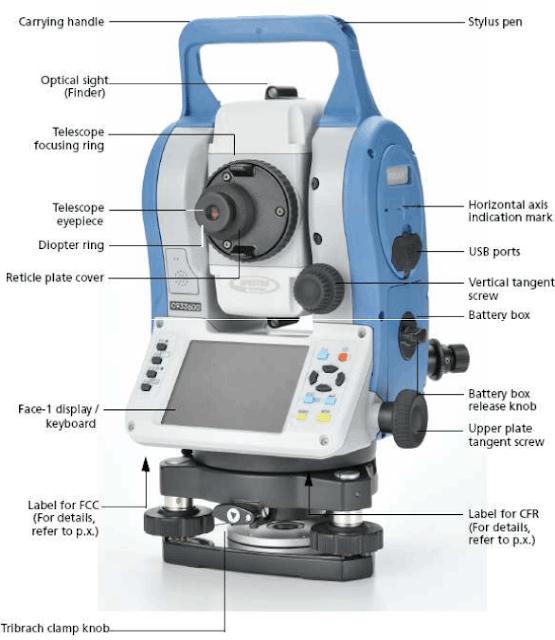
Parts of the Total Station
- Handle and securing screw
- Data input/output terminal
- Instrument height mark
- Battery cover
- Operation panel and display
- Tribrach clamp and base plate
- Leveling foot screws
- Circular level and plate level
- Objective lens
- Telescope eyepiece and focusing ring
- Horizontal and vertical clamps
- Fine-motion screws
- Optical plummet
- External power connector
Components of Total Station
The microprocessor unit includes a keyboard with command and function keys. The internal database stores several thousand survey points. Reflector prisms return the emitted signal for accurate distance measurement. The electronic display shows angle, distance, and coordinate values. Data can be transferred to a personal computer for CAD and GIS processing. Rechargeable batteries typically provide 2 to 10 hours of continuous operation.
Capabilities of Total Station
- Measurement of averaged horizontal and vertical angles
- Measurement of averaged distances
- Computation of horizontal distances
- Distance between any two observed points
- Determination of elevations
- Calculation of three-dimensional coordinates
- Area and volume computation
Working Principle of the Total Station
Total stations emit modulated infrared or microwave signals toward a reflector. The phase shift between transmitted and received signals is analyzed to determine distance. Electronic encoders measure angles. Using trigonometric relationships, the instrument calculates horizontal distance, elevation difference, and spatial coordinates of surveyed points.
Instrument Manufacturers
- Carl Zeiss
- Leica Geosystems
- Topcon
- Trimble
- Sokkia
- Nikon
- GeoMax
- Pentax
- CST/Berger
Advantages of Using Total Stations
- High measurement accuracy and precision
- Reduced recording and computation errors
- Time-efficient surveying operations
- Digital data storage and transfer
- Multiple observations from a single setup
- Integration with CAD and GIS software
- Area and volume computation capability
Disadvantages of Total Station
- High initial purchase cost
- Requires skilled operators
- Battery dependency
- Improper leveling may affect elevation accuracy
Conclusion
The total station represents a major advancement in surveying practice. By integrating angle measurement, electronic distance measurement, and onboard computation, it improves accuracy, efficiency, and reliability in field operations. It reduces manual workload, minimizes errors, and enables precise coordinate determination for civil engineering, construction, mining, and infrastructure projects. Due to its versatility and precision, the total station remains an indispensable instrument in modern surveying.